Tzedakah Box: What It Is, Where to Put One, and How to Choose
Add 1800Eichlers as a preferred source on Google
A pushke is one of the few Jewish ritual objects that earns its place by being used constantly rather than once a year. It sits out in the open, collects small change, and turns giving into a habit instead of a decision. This guide covers what it is, where it belongs in your home, when coins go in, how much to give, and how to choose one that will actually get used.
Quick Summary
A tzedakah box, called a pushke in Yiddish, is a container kept in the home for setting aside charity money. It has no halachic requirements of its own as an object, so any material works. Most families keep one beside the Shabbos candles and add coins before lighting, and many keep additional boxes in children's rooms, the kitchen and the office.
- Any material is acceptable. The mitzvah is the giving, not the box.
- Near the Shabbos candles is the most common spot, because coins are given before lighting.
- More than one box is normal. Kitchen, entrance, child's room and desk are all usual.
- Coins go in before Shabbos, not during it, since money is not handled on Shabbos.
- Maaser kesafim, a tenth of income, is the widely cited measure. Confirm the details with your Rav.
- For children, pick something unbreakable and easy to open. Visible progress keeps them interested.
| Use | What suits it | Why |
|---|---|---|
| Shabbos table | Silver or silver tone, often paired with a match holder | Matches the table and sits by the candles |
| Everyday kitchen use | Acrylic or lucite | Light, durable, easy to wipe clean |
| Child's room | Acrylic, clear or coloured | Unbreakable, and children can see it filling |
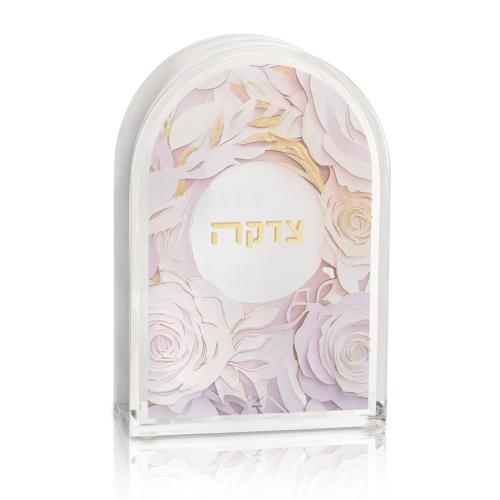
| Gift or display | Papercut, leatherite or decorative artwork | Reads as a finished piece rather than a container |
| Office or desk | Small acrylic or metal | Keeps giving part of the working day |
What This Guide Covers
What Is a Tzedakah Box?
It is a container kept in the home, office or classroom for setting aside money for charity. Money goes in over time, and the contents are given to people or causes in need. The box itself has no ritual status, which is why it can be made of almost anything.
Its job is behavioural rather than ceremonial. Having a dedicated container in a visible place turns giving from something you remember occasionally into something built into the week.
Why is it called a pushke?
Pushke is the Yiddish word for the box, and it is what most Ashkenazi families actually say at home. The English term refers to the same object. You will see both used on product listings and in conversation, and neither is more correct than the other.
What is the difference between tzedakah and charity?
Charity in English suggests generosity that is optional. Tzedakah comes from the Hebrew root meaning righteousness or justice, and in Jewish practice it is treated as an obligation rather than a kindness. That difference is the reason a Jewish home keeps a dedicated box rather than giving only when asked.
It also explains why the amount matters. If giving were purely voluntary, there would be no need for a measure. Because it is treated as a duty, there is a standard, which the section below covers.
Why Keep One at Home?
Because consistency is the hard part. Most people intend to give and then do it irregularly. A box on the counter removes the decision, since the money is already set aside before anyone asks for it.
- It makes giving routine. Coins go in at fixed moments rather than when you happen to think of it.
- It teaches children by repetition. A child who drops in a coin every Friday learns the habit, not just the idea.
- It separates the money in advance. Funds set aside are easier to give than funds still mixed in with everything else.
- It keeps the mitzvah visible. An object on the counter is a reminder in a way an app is not.
Where Should You Put a Tzedakah Box?
Next to the Shabbos candles is the most common placement in a Jewish home, because coins are traditionally given just before lighting. Beyond that, the rule is practical: put it where the moment of giving already happens.
The most common places in a Jewish home
| Location | Who uses it | The moment it captures |
|---|---|---|
| Beside the Shabbos candles | Whoever lights | Before candle lighting on Friday |
| Kitchen counter | The whole family | Loose change through the week |
| Entrance hall | Family and guests | On the way out of the house |
| Child's bedroom or playroom | Children | Pocket money and allowance |
| Desk or davening spot | Adults | Before davening |
| Office | Staff and visitors | During the working day |
Do you need more than one?
Most households end up with several, and that is normal rather than excessive. Each box captures a different moment, and a box nobody passes is a box nobody uses. A practical starting set is one by the candles, one in the kitchen and one per child.
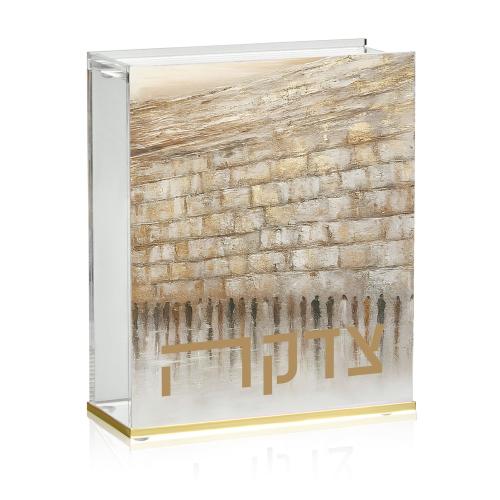
If you are buying several at once, keeping them visually consistent makes the set look deliberate rather than accumulated. The tzedakah boxes collection at 1800 Eichlers is organised by material and style, which makes matching straightforward.
When Do People Put Money In?
There are a few recurring moments rather than one fixed rule. The two most common are before lighting Shabbos candles and before davening. Beyond that, people add coins when something good happens, before a journey, and at points in the year associated with giving.
Before lighting Shabbos candles
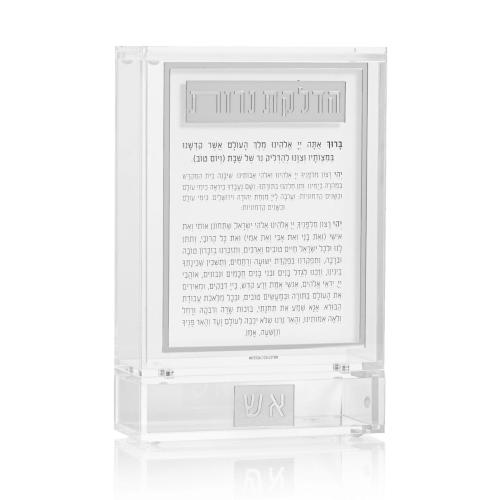
This is the placement that drives most purchases. Coins are given before the candles are lit, which is why many boxes are sold as part of a set with a match holder, designed to sit together on the same tray.
If your box lives somewhere else in the house, this is worth fixing. The moment is specific and weekly, and a box in the wrong room misses it every time.
Before davening
Giving before prayer is a long established practice, and a small box kept wherever you daven makes it practical. This is one of the better arguments for owning more than one box, since the candle lighting box is usually in the kitchen or dining room.
Can you give tzedakah on Shabbos or Yom Tov?
Money is not handled on Shabbos or Yom Tov. That is precisely why the custom is to give before candle lighting rather than during Shabbos itself. Some families set aside an amount in advance to cover what they would otherwise have given.
Specific situations, including a box that is handled or moved on Shabbos, are worth asking your Rav about rather than resolving from a general guide.
How Much Tzedakah Should You Give?
The widely cited measure is maaser kesafim, a tenth of income. A fifth is commonly described as an upper limit on regular giving. These are the figures most people encounter, and both the calculation and the exceptions carry real detail.
What is maaser kesafim?
Maaser kesafim means tithing money, setting aside a tenth of income for tzedakah. The practical questions start immediately: income before or after tax, whether certain expenses are deducted first, how it works for irregular earnings, and what counts toward the total.
Those questions have answers, but they are not one-size-fits-all, and getting them from a blog is the wrong approach. Put them to your Rav. If you want to read the sources yourself, the halacha seforim collection covers this area.
What the box does is separate from the percentage. Coins in a pushke are rarely the whole of what a family gives. The box handles the daily habit while larger amounts are usually given directly.
What Are the Eight Levels of Tzedakah?
The Rambam set out a well known ranking of eight levels of giving, ordered from the least to the most meritorious. It is widely taught because it reframes the question from how much to how.
| Level | Description |
|---|---|
| 8 | Giving unwillingly or with visible reluctance |
| 7 | Giving less than you should, but giving it gladly |
| 6 | Giving only after being asked |
| 5 | Giving before being asked |
| 4 | The recipient knows the giver, but the giver does not know the recipient |
| 3 | The giver knows the recipient, but the recipient does not know the giver |
| 2 | Neither party knows the other |
| 1 | Helping someone become self sufficient, through a gift, a loan, a partnership or work |
Everyday giving from a pushke sits naturally in the anonymous middle levels, since coins collected at home are usually passed on without the recipient knowing the source. That is a reasonable place for everyday giving to live.
How Do You Choose One?
Since there are no halachic requirements for the object itself, the choice is practical and aesthetic. The questions that matter are where it will sit, who will use it, and how it opens.
Which material is best?
| Material | Best for | Things to know |
|---|---|---|
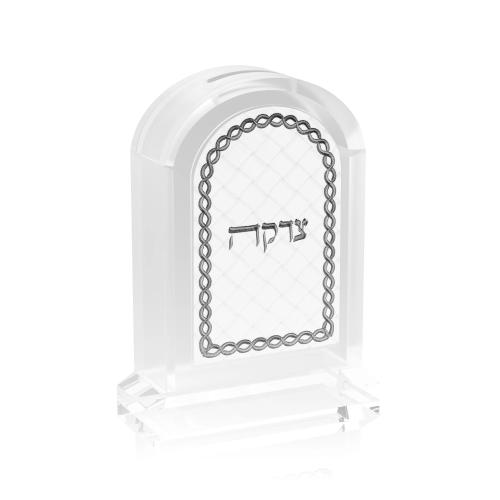
| Acrylic and lucite | Daily family use, children's rooms | Light and hard to break. Clear versions show the money building up |
| Silver and silver tone | Shabbos table, gifts | Matches candlesticks. Often sold with a matching match holder |
| Leatherite | Display shelves, office | Woven and artwork finishes, heavier look without the weight |
| Papercut and decorative | Gifts and display | Reads as a decorative piece rather than a container |
What size should you get?
Bigger is not better. A large box takes a long time to fill, which removes the small satisfaction of finishing one and passing the money on. A box that fills every few weeks keeps the cycle visible, particularly for children.
Does it need a lock, and how does it open?
Check the opening before you buy, because it is the detail people overlook. Boxes open by a sliding base, a removable lid, a screw plate or a key. A sealed box that needs tools is a nuisance when you empty it regularly.
- Sliding or removable base: easiest for a box emptied often.
- Lidded: simple, though coins can spill when carried.
- Locked: suits a shul or office where a box is shared.
- Sealed collection boxes: usually belong to an organisation and are returned rather than opened.
Choosing One for Children
A child's box should be unbreakable, easy to open, and ideally clear so progress is visible. Those three things matter more than design, because the aim is a habit rather than an ornament.
- Give it a fixed moment. Friday before candles works because it repeats.
- Let them put the coin in themselves. The physical act is what sticks.
- Empty it together. Counting and deciding where it goes is the part they remember.
- Let them choose the cause. Ownership keeps it going.
- Keep it in their room. A box they pass daily beats one on a high shelf.
Personalising a box with a child's name makes it theirs in a way a generic one is not. 1800 Eichlers offers personalisation across a range of Judaica, and the children's range and toys and games cover the rest of a child's Jewish shelf.
Giving One as a Gift
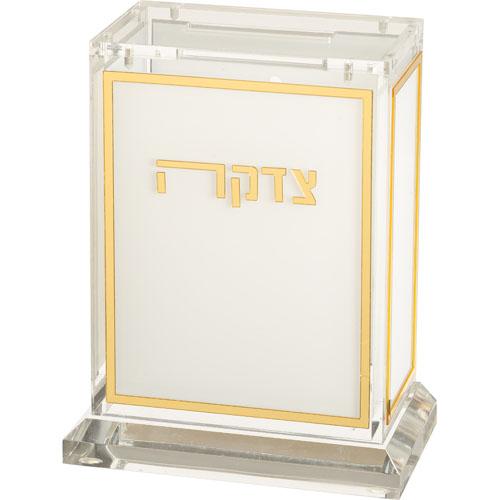
It is a strong gift for occasions where the recipient is setting up a home or marking a milestone. It is useful, it is not duplicated often, and it carries meaning without being purely decorative.
| Occasion | Why it works | Pairs well with |
|---|---|---|
| Wedding or new home | Among the first things set out in a new kitchen | Candlesticks, a Shabbos tray |
| Bar or bat mitzvah | Marks taking on mitzvos personally | A personalised engraving |
| Housewarming | Useful rather than ornamental | A mezuzah case |
| Teacher or rebbe | Appropriate for a classroom | A matching desk piece |
For more gift ideas by occasion, the Judaica gifts range and the wedding and new home collection are the places to start. For a milestone gift, see bar mitzvah gifts.
Shop Tzedakah Boxes at 1800 Eichlers
1800 Eichlers carries tzedakah boxes in silver and silver tone, acrylic and lucite, leatherite and papercut designs, in sizes suited to a Shabbos table, a kitchen counter, a desk or a child's room. Several are sold as sets with a matching match holder for candle lighting.
Browse the full tzedakah boxes collection, add a name or dedication through personalised gifts, or see how a box fits the rest of the table in the Shabbos table collection. For the wider home, there is also Jewish home decor and Judaica artwork.
About 1800 Eichlers
1800 Eichlers is a Judaica superstore based at 5004 13th Ave in Borough Park, Brooklyn, serving Jewish communities across the United States and worldwide through 1800eichlers.com. The Judaica collection includes tzedakah boxes in every style and size, alongside a full range of Shabbos, holiday and lifecycle items for the Jewish home. Questions about a specific box, its size or how it opens can be answered by the store on (718) 874-9771.
Frequently Asked Questions About Tzedakah Boxes
- What is a tzedakah box?
A tzedakah box is a container kept in the home, office or classroom for setting aside money for charity. It is commonly called a pushke in Yiddish. Coins go in at regular moments such as before lighting Shabbos candles, and the contents are given to those in need.
- What is a tzedakah box used for?
It collects small amounts of money over time so that giving becomes a steady habit rather than an occasional act. Keeping it visible also teaches children that charity is part of ordinary daily life in a Jewish home.
- Where should you put a tzedakah box?
Most homes keep one near the Shabbos candles, since coins are traditionally given before lighting. Other common spots are the kitchen counter, the entrance hall, a child's bedroom and a desk where people daven.
- Why is a tzedakah box called a pushke?
Pushke is the Yiddish word for the box, and it is the term most Ashkenazi families use at home. Tzedakah box is the English equivalent. Both refer to the same object and the words are used interchangeably.
- How much tzedakah should you give?
The widely cited practice is maaser kesafim, meaning a tenth of income, with a fifth sometimes described as an upper limit. Amounts and how they are calculated vary by circumstance, so this is a question to put to your Rav.
- Can you put money in a tzedakah box on Shabbos?
Money is not handled on Shabbos or Yom Tov, which is why coins are given before candle lighting rather than during Shabbos itself. Ask your Rav about any specific situation.
- What material should a tzedakah box be?
There is no halachic requirement for a particular material. Acrylic and lucite suit everyday family use, silver and silver-tone designs suit a Shabbos table or a gift, and leatherite and papercut designs sit well in a display setting.